


Management Reporting
Financial Modelling
Driver-based Planning
Scenario Modeling
Management Reporting
AI Forecasting
Driver-based Planning
Scenario Modeling
All-in-one financial planning software trusted by 500+ brands.
Come and join the party...




One Platform. Every FP&A Workflow You Need.
Most FP&A software do one thing well. Blox does everything; financial planning, modelling and analysis, budgeting, business forecasting, management reporting and financial analytics, all sharing the same data, the same models and the same source of truth. No more switching between systems. No more reconciling versions. Enterprise finance teams and emerging businesses run the same platform built to the highest industry standards.

FP&A Automation

Stop Rebuilding the Same Report Every Month
Every finance team has work they shouldn't still be doing manually. Data pulls that take hours. Reports that get rebuilt from scratch each period. Variance tables that someone has to populate by hand. Blox eliminates that layer entirely, automating data consolidation, pulling actuals directly from your connected systems, and generating reports without anyone in the team having to chase a number. Your CFO spends less time in spreadsheets and more on strategy. Your analysts get to do analysis.

Management Reporting

Reports the Board Will Actually Read - Ready Before the Meeting
The problem with most management reporting isn't the data; it's the hours spent making the data presentable. Blox produces clean, consistent management packs, board reports and KPI dashboards trusted by finance teams across diverse industries, from professional services and SaaS to retail and financial services. Every figure ties back to a live source. Every report follows the same structure. And Blox analytics shows you why when something moves.

Financial Planning

A Budget That Reflects the Business You're Actually Running
Most organisations complete their annual budget and then spend the rest of the year watching it become irrelevant. Blox changes that dynamic. With driver-based business budgeting software that connects assumptions to outcomes, demand planning built into the same model, and every department contributing through a single workflow, your budget stays meaningful long after January. Pair it with rolling forecasts and strategic financial planning tools and you've got a living financial picture, not a frozen snapshot.

Powerful Modeling

Build the Model Your Business Actually Needs - Not the One That Fits a Template
Off-the-shelf models are built for someone else's business. Blox gives finance teams; from growth-stage companies to multi-entity enterprises, a modelling environment flexible enough to handle anything: cost management structures, revenue drivers, project-level profitability, headcount scenarios, multi-entity consolidation. Build in the logic your business runs on. Change assumptions without breaking formulas. Run scenarios in seconds. This is financial modelling that keeps pace with decisions, not one that delays them.
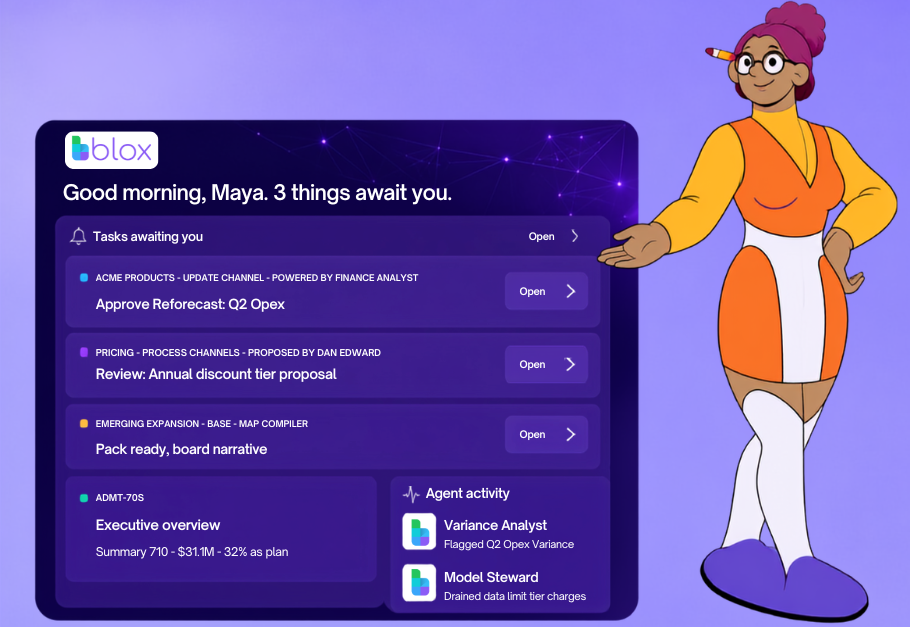
Stop Building Every Model From Scratch
Specialist agents that build, answer and plan, with your approval built in
Every finance team ends up rebuilding the same block, chasing the same missing dimension, or explaining the same model to a chatbot that forgets it by the next message. Blox AI removes that friction. Specialist agents read your live model, propose the block, formula or scenario you need, and apply it the moment you approve. Building by hand becomes optional, your finance team spends less time wiring formulas and more time reviewing what matters. Your finance team gets an agent that already knows the business.
Three Things Finance Teams Should Be Doing - But Usually Can't
Most finance functions are stretched too thin to step back. The reporting cycle eats the week, the budgeting process eats the quarter, and there's rarely time left for the work that would actually change something. Blox is built to flip that balance; giving teams across industries and scales the infrastructure for cash flow forecasting, enterprise planning and enterprise performance management without the overhead that usually comes with it.
1. Automate
Build the Infrastructure That Works Without You
The best FP&A operations aren't the ones with the most analysts; they're the ones that have removed the manual layer entirely. Blox connects to your ERP, accounting platform and CRM and keeps data flowing without anyone managing it. Whether you're a scaling startup or a large enterprise with complex data architecture, your financial reporting software runs itself.


2. Analyse
See the Story Inside the Numbers
Numbers without context are just noise. Blox surfaces the signal; turning your financial data into financial analytics that highlight what changed, what drove it and what needs attention. Dashboards your leadership team can navigate on their own. KPI views that stay current without a weekly refresh.

3. Plan
Build Confidence Into Every Financial Decision
Cash flow management, demand planning, business forecasting, scenario modelling, strategic financial planning; these aren't nice-to-haves for ambitious finance teams, they're the job. Blox gives you the tools to build plans that hold up to scrutiny and update when the business changes. Every assumption traceable. Every output explainable.

.png)

.png)

.png)


What Changes When Your FP&A Modelling Software Actually Works
A lot of financial planning and business forecasting software promises transformation and delivers a slightly better Excel alternative. Blox is different; it is much more than just an alternative to Excel, not because of features, but because of what it removes. The reconciliation work. The version confusion. The gap between what finance knows and what leadership sees. Blox is a cloud-based CPM software and EPM software platform deployed by finance teams at enterprises and high-growth businesses across diverse industries. Blox centralises everything and makes the insight available to everyone who needs it, whether that's a seed-stage startup or a global enterprise running financial planning and analysis software across multiple entities.
 Increased Efficiency
Twenty-plus hours reclaimed per month, not from working faster, but from eliminating work that should never have existed in the first place.- Enhanced Accuracy
When your financial forecasting and reporting draw from the same live dataset, version conflicts stop being a problem. There is one number. Everyone sees it. - Simplified Reporting
Management reporting that reaches the right people in the right format before the meeting, which explains the movements, not just the figures. - Scalable Solution
Financial planning and analysis software that works for a ten-person startup and a two-hundred-person enterprise without needing to be rebuilt in between.
Your Numbers Already Exist Somewhere: Blox Financial Planning Software Brings Them Together
The worst version of financial planning and business forecasting is the one where the finance team spends most of its time moving data from one place to another. Blox ends that. By connecting directly to the systems where your financial data actually lives; your ERP, your accounting platform, your CRM, your HRIS, Blox handles the data consolidation layer automatically. What arrives in your reports, your forecasts and your models is current, clean and complete. Running on cloud-based financial planning software means every integration stays live. You don't refresh, Blox refreshes for you.



Sage
Whether you use Sage 50 or Sage 200, Blox connects your accounting data to modern budgeting, forecasting, and scenario planning - without disrupting your existing workflows.


Excel
Blox integrates with Microsoft Excel to bring custom data, legacy systems, and one-off analyses into your unified planning environment.
.webp)
Sage 200
Your Sage 200 general ledger feeds directly into Blox planning and reporting; actuals update automatically, period close becomes faster.
.svg)
Sage 50
Your Sage 50 general ledger feeds directly into Blox planning and reporting; actuals update automatically, period close becomes faster.
Modern finance teams have already decided
These aren't pilot users or design partners. These are CFOs, CEOs and finance leads; from startups to established enterprises across multiple industries, who moved to Blox financial planning & business forecasting software, and haven't looked back ever since.


“Blox has been a game changer for FunnelFuel. As a B2B marketing platform, we work with a diverse range of brands and agencies; with planning and forecasting challenges throughout the year. Our finance team are saving 20+ hours per month with Blox whilst gaining a single source of truth for our numbers in our business."
FunnelFuel


“All the data is in one place and it actually tells a story. One of our big funders was holding off agreeing to our next three years' funding until we could prove that we could provide reports and plans broken down in a certain way. We reached out to Blox for help… The end result? We got the extra funding, and it's guaranteed for the next three years!"
Time to Talk Befriending

“Blox makes it really simple for us as the users to go in, edit the model ourselves and see in real-time how changes to the model affect the changes to the projections. That really helps us, not just from a business planning perspective, but also to tweak the model in relation to questions from investors"
Legal Connection

“We were facing challenges with accurately forecasting our resource needs and project profitability. We purchased Blox to provide us with a standardized template and workflow that would help us consistently quote projects, plan our resources, and get a clear view of how each project is performing against budget."
Auteur Group

“Blox software and expertise helped double acquisition valuation – a remarkable result! I couldn't be happier and highly recommend their services to anyone seeking phenomenal outcomes."
Delighted Customer

“Blox helped us get our EIS application approved! HMRC wanted financial projections for the business so we were lucky to come across both the platform and the team at Blox, who understood what we were looking for. What we created with Blox not only met the standard that HMRC was looking for, but were extremely useful internally."
Klar Water


Insights Built for Finance Teams Who Want to Get Ahead
There's a lot of noise in the FP&A space. What you'll find here is insightful and easy-to-read content on financial forecasting, AI finance, strategic financial planning and what modern FP&A actually looks like in practice.

Templates
Start with a model that's already thought through. SaaS revenue models, three-statement models, budgeting and forecasting templates, headcount planners; built by people who've done this professionally. Grab one, connect your data, and you're building rather than starting from scratch.


Our Blog
Explore thinking that moves finance forward. Real-world takes on cash flow management, forecasting software, AI finance tools and building a finance function that actually influences decisions. Written by practitioners, not marketers.

The Finance & Technology Pod
Stay abreast of the conversations finance leaders are having. Blox CEO Simon sits down with CFOs and finance leaders to talk about enterprise performance management, where FP&A automation is heading, and what separates finance functions that lead from those that lag.


